 |
Austria-Hungary
Left ~ 18th Cent. The 13 indicates silver purity, 13/16 lothig or .813, year 1753
Right ~ 19th Cent. until 1886. The letter at top indicates town, A = Vienna, year 1857 |
 |
Austria-Hungary
Top ~ 1886 - 1922. Diana head mark, number at left indicates silver purity, 3 =.800. Letter on right indicates city, P = Pest.
Austria
middle ~ 1922 - Present. Toucan head, letter on left indicates city, W= Vienna. Silver purity marked separately by #4 = .750
bottom ~ 1922 - Present. Hoopoe head, letter on right indicates city, W= Vienna. Silver purity marked separately by #3 = .835, #2 = .900, #1 = .935, the stamp shape containing the bird's head changes with the purity number.
|
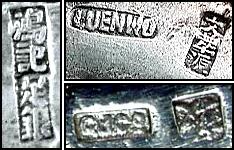 |
China
Late 19th & Early 20th centuries.
|
 |
Czech Republic
Marks in current use.
|
 |
Denmark
1888 - Present
Top ~ Silver must be marked with a maker's mark and fineness in thousandths (top).
Bottom ~ It may also be marked with the Copenhagen assay mark (3 towers above date) and
with the Assayer's initials (ill. example - C.F. Heise)
Danish Maker's Marks |
 |
Egypt
1906 - Present
The Cat figure was replaced by the Lotus Flower in 1946 |
 |
Finland
1810 - Present
Left to right ~ Maker's Mark, National Mark, silver purity, Town Mark (Turku) and Date Mark
Key to Finland Date Marks |
 |
France
Silverplate marks
Maker's mark in a rectangle as opposed to the diamond shape used on silver. Numeral indicates silverplate thickness.
French Silver & Gold Marks |
 |
Germany
1884 - Present?
The crown & crescent are the state mark and are followed by a numeric standard mark and usually a maker's mark (symbol, initials or full name). Prior to 1884, instead of the crown & crescent, each city had its own symbol and silver purity was sometimes marked on the lothige system with a number 12 or more commonly 13.
More German Marks |
 |
Iran
20th Cent.
|
 |
Ireland
c.1730 to Present
Example has the (harp) town mark for Dublin.
Dublin Date Marks |
 |
Italy
1 ~ From 1872 - rarely used
(an .800 stamp is more common)
2 ~ Fascist period 1934 - 1944
3 ~ 1944 to 1968
4 ~ 1968 to Present
In the last three examples, the number would be registered to an individual maker, the initials represent the region (ie. FI = Firenze)
For a fuller overview of 20th Century Italian marks, visit ASCAS
|
|
 |
Latvia
20th Cent.
Silver purity in thousandths (.875 or .916) plus initialed Maker's Mark.
Top~ Local production
Bottom ~ Imported ware. |
 |
Netherlands
1814 - 1953
Lion mark is silver purity (1 =.934, 2 =. 833), Head is duty mark, Letter is date mark (x = 1932). Maker's Mark (far left) for Zilverfabriek Voorschoten.
Key to Dutch Silver Date Marks |
 |
Poland
Top ~ since 1920
Number indicates silver purity (3 =.800). Letter indicates city of assay (w = Warsaw).
Later examples show head above purity number and city initial on kerchief.
Bottom ~ Marks in current use.
|
 |
Portugal
1886 - 1938
Mark used on large articles. A seated boar was also used. |
 |
Russia
Top ~ c.1750 - 1896
Left to right ~ Maker's Mark, Assayer's Mark above year, silver purity and Town Mark (St. Petersburg)
Bottom left ~ 1896 - 1908, Assayer's initials to right of head also indicate town.
Bottom right ~ 1908 - 1917, Symbol to left of head indicates town.
|
 |
Scotland
18th cent.- present
This example has the town mark of Edinburgh. |
 |
Spain
1934 - Present
Pentagram is a quality mark indicating a minimum of .915 purity, it is usually accompanied by a
maker's mark in a hexagonal stamp or an importer's mark in a triangle. |
 |
Switzerland
Top: 1882 - 1934
Bear - .875 and above. Grouse - .800
Bottom: 1934 - Present?
Duck - .925 Grouse - .800
Hallmarks compulsory for watch cases,
optional on all other silverware.
|
 |
Turkey ~ Ottoman Empire
? - 1923
|
|


